5 minute read
Some of the same companies that cut roles in the name of AI efficiency are now paying a premium to bring those people back.
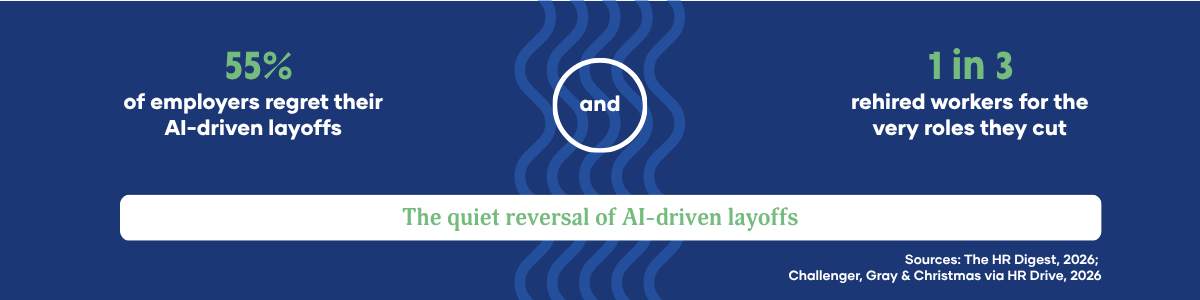
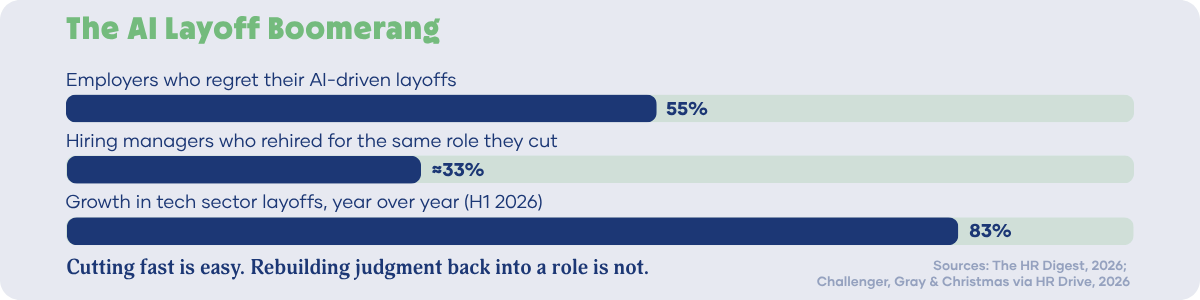
New reporting on 2026 layoffs found that up to 55 percent of employers regret their AI-driven layoffs, and nearly a third of hiring managers who eliminated roles for AI automation have had to rehire humans for those same jobs.1 The reversal comes as AI-linked job cuts keep climbing. Tech alone announced nearly 140,000 layoffs in the first half of 2026, up 83 percent year over year, and AI has been the top cited driver of job cuts for four straight months.2
The Jobs Companies Are Bringing Back
The roles seeing the highest rate of rehiring aren't the ones that are easiest to automate. They're the ones that sit in the middle of an organization: mid-level managers, customer success leads, quality assurance specialists, the people who translate strategy into execution and catch problems before they reach a client.
These are what some are calling the “connective tissue” roles, positions that depend on cross-departmental negotiation, emotional intelligence, and a working read on what a client or colleague needs, even when they haven't said it directly. Cut those roles and the org chart looks lighter. The work those people were doing didn't disappear, though. It just stops getting done until someone notices it.
What Got Skipped: The Judgment Layer
None of this means the tools failed at what they were built to do. Parsing large datasets, drafting routine documents, spotting patterns at speed, AI does that well. The trouble starts when those capabilities get mistaken for a substitute for the parts of a job that require understanding people: reading a tense meeting, repairing a relationship after a mistake, negotiating around a policy that doesn't quite fit the situation in front of you.
The lesson isn't that AI doesn't belong in the workplace. It's that it can't replace the parts of hiring and workforce planning that require understanding people, and treating those parts as optional is what's driving companies to undo their own layoffs.
Why This Keeps Catching Companies Off Guard
Most workforce planning decisions get made on the metrics that are easy to measure: headcount, cost per function, output per role. What rarely gets measured, and what almost never shows up on a spreadsheet, is which people in those roles are carrying out the organization's judgment work. The employee who defuses a client's frustration before it becomes a churn risk. The manager who reads a team's morale correctly and adjusts before the project stalls. That work is invisible right up until it's gone.
It doesn't help that manager engagement itself is already sliding. Gallup's 2026 State of the Global Workplace report found manager engagement dropped from 27 percent to 22 percent since 2022, the steepest year-over-year decline on record.4 The people whose judgment is supposed to hold a team together are, by Gallup's own numbers, some of the least engaged people in the building right now, and cutting their roles because a spreadsheet flagged the headcount as redundant tends to prove the opposite point.
This is precisely the gap validated personality assessment is built to close. Traits like Conscientiousness and Emotional Stability are consistently among the strongest predictors of job performance in organizational psychology research, and they show up most clearly in exactly the ambiguous, high-judgment situations that automation struggles with.3 A validated, personality instrument can surface who's doing that kind of work, and how well suited a role is to automation versus human judgment, before a layoff decision gets made. An algorithm optimized for cost per headcount has no way to see that layer at all.
The Real Lesson for Workforce Planning
Rehiring the person you laid off six months ago, often at a higher salary than before, is an expensive way to relearn something a good workforce plan should have caught the first time. Companies that build restructuring and automation decisions around validated insight into how people actually work, not just what their role is titled, are far less likely to end up back where they started.
Sources
Coker, D. (2026). Companies are rehiring people they replaced during AI layoffs. The HR Digest. thehrdigest.com
Alexis, A. (2026). Tech accounts for nearly a third of US layoffs in the first half of 2026, Challenger finds. HR Dive. hrdive.com
Barrick, M. R., & Mount, M. K. (1991). The Big Five personality dimensions and job performance: A meta-analysis. Personnel Psychology, 44(1), 1–26.
Gallup. (2026). State of the Global Workplace 2026. gallup.com
Read More
• Why Your Last Personality Assessment Didn't Stick, and What the Science Says About Why — The science behind lasting behavior change, and why a report alone rarely delivers it.
• What Looks Like a Team Problem Is Usually a Perception Problem, and It's Costing You — Why the friction that erodes performance rarely looks like conflict until it's already expensive.
• The Big Five and the WorkPlace Big Five Profile®: What's the Difference, and Why Does It Matter? — What the research says about personality measurement, and how Paradigm makes it useful for organizations.